
On Worrying and Setting Right Priorities
So far this year it seems like I’ve had more conversations than normal on the issue of setting priorities. Or at least that’s where we end up. We often start out thinking through anxiety, overwhelm, and a compulsion to control. Women are worrying. About a lot of things. An aging mom‘s…
Psalm 37:3-7 (CSB)
3 Trust in the Lord and do what is good;
dwell in the land and live securely.
4 Take delight in the Lord,
and he will give you your heart’s desires.
5 Commit your way to the Lord;
trust in him, and he will act,
6 making your righteousness shine like the dawn,
your justice like the noonday.
7 Be silent before the Lord and wait expectantly for him;
do not be agitated by one who prospers in his way,
by the person who carries out evil plans.
Luke 10:38-42 (ESV)
38 Now as they went on their way, Jesus entered a village. And a woman named Martha welcomed him into her house. 39 And she had a sister called Mary, who sat at the Lord's feet and listened to his teaching. 40 But Martha was distracted with much serving. And she went up to him and said, “Lord, do you not care that my sister has left me to serve alone? Tell her then to help me.” 41 But the Lord answered her, “Martha, Martha, you are anxious and troubled about many things, 42 but one thing is necessary. Mary has chosen the good portion, which will not be taken away from her.”
So far this year it seems like I’ve had more conversations than normal on the issue of setting priorities. Or at least that’s where we end up. We often start out thinking through anxiety, overwhelm, and a compulsion to control. Women are worrying. About a lot of things. An aging mom‘s dependence on pain pills. A brilliant daughter whose grades have plummeted. A husband won’t listen no matter how carefully his wife chooses her words. What kind of world will be left for our children to inherit. These are real conversations. Real burdens.
It’s these burdens that prompt a deep dive in the counseling room into what it looks like to honor God when you suspect you can’t do it all but feel like you have to try. The women I’m working with are seeking to grow in discernment and grow in wisdom. We are asking hard questions. What part of this is mine to do? What part is someone else’s? And what do I do if they don’t?
I’m reading Alan Noble’s new book, To Live Well, and this sentence from the introduction stopped me:
”Look beneath the usual culture war hot topics, look beneath the appearances of justice to see what Christ is calling us to, what our right obligations are, and how we can practice those in the world that demands everything of us all time.”
Obligations? Yes. But right obligations. A yoke that fits us. The yoke where Jesus is carrying the heavy side. Setting priorities correctly means learning to discern when to trust and how to obey. It takes knowing when the “to do” is wait and pray.
God help us, in and out of the counseling space, to turn away from demands to do, have, and be everything so that we can learn the “one thing needed,” in all the areas of our life.
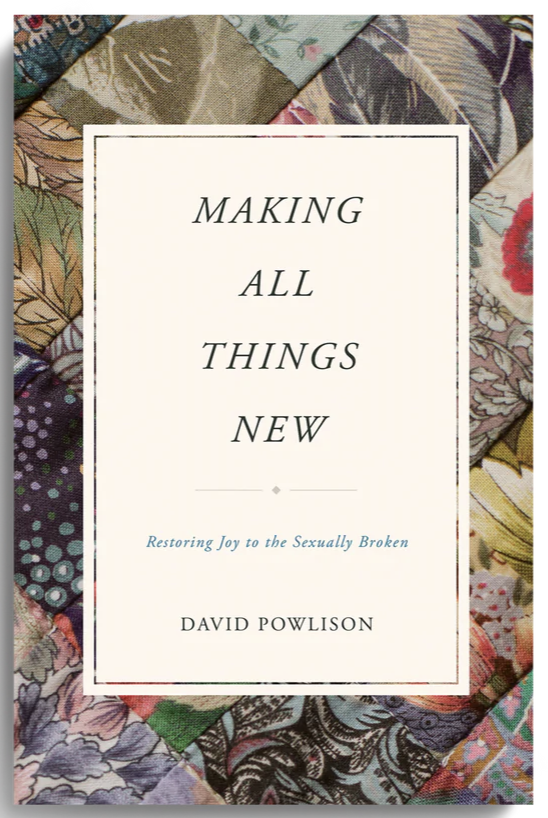
Good Endings: Learning from Powlison about Restoring Joy for the Sexually Broken
As a biblical counselor to women, I regularly find myself in the privileged role of walking alongside those facing sorrow in their lives because of the impact of sin on God’s good gift of sex and sexuality. As a woman who lives in that same fallen world, I have benefitted greatly from the message of hope and renewal found in this honest, compassionate, and eminently practical book. I reread it nearly every year, and I wholeheartedly recommend it for those wanting to understand steps they can take toward Jesus as they seek the renewal only he can give.
David Powlison might be the only author I have ever read whose books I have recommended to friends, family, and counselees without any qualification. Throughout his ministry counseling and equipping counselors, he addressed the hard issues with the right measures of urgency and winsomeness. His short book, Making All Things New: Restoring Joy to the Sexually Broken, is no different.
One of the most unique things about this book is Powlison’s audience. Many books addressing sexual brokenness understandably adopt an either/or approach. There are solid books written to victims of sexual sin, and there are helpful resources for those struggling with a variety of sexual temptations. There are really helpful books on healthy and holy sex in marriage, and books on meaningful, joyful singleness. Powlison takes the road less traveled in addressing the victim, the sinner, the spouse, and the single person (acknowledging along the way that most of us fit more than one of those categories in different seasons of our lives). It’s rather remarkable he attempted such an ambitious goal, and more remarkable still that he succeeded so thoroughly, undoubtedly because he wrote with Christ-dependent humility and thoughtful dependence on God’s Word.
Powlison’s summary of Scripture’s message on sexuality captures this approach and highlights a core theme of the book: gospel renewal is for all of us.
“In sum, the Lord has a highly positive view of sex. He has a highly negative view of immorality. And he has a deep concern both for the consensually immoral and for the victims of the criminally immoral. He has more mercy than we can imagine. Of course, there are not two gospels, one for sinners and one for sufferers! There is the one gospel of Jesus Christ, who came to make saints of all kinds of sinner-sufferers and sufferer-sinners, whatever our particular configuration of defections and distresses.” (p. 19)
A second strength of Making All Things New is how it works like powerful camera lens, able to capture the wide panoramic foundational issues and background context, while also proving capable of zeroing in on practical details with focus that makes its counsel livable in the day-to-day.
This focus from wide to close-up is at its best in the middle chapters of the book, each considering renewal from a different angle. An encouraging example of this is in chapter four, where Powlison considers the timeframe, pacing, and duration of renewal. A key takeaway: because renewal is lifelong, repentance is a lifestyle. There is no “one and done” method, no “shock and awe” version of recovery from sexual addiction or healing from sexual abuse. Powlison fleshes out the theological concept of progressive sanctification practically. He says, “Sanctification is a direction,” and wisely helps strugglers and sufferers be intolerant of despair and lust while also being patient with their own growth and healing by placing their trust in their Lord step by step. He memorably quotes Luther to drive in this point:
This life is not righteous, but growth in righteousness; it is not health, but healing; not being, but becoming; not rest, but exercise; we are not yet what we shall be, but we are growing toward it; the process is not yet finished, but is going on; this is not the end, but it is the road; all does not yet gleam in glory, but all is being purified. (68)
As a biblical counselor to women, I regularly find myself in the privileged role of walking alongside those facing sorrow in their lives because of the impact of sin on God’s good gift of sex and sexuality. As a woman who lives in that same fallen world, I have benefitted greatly from the message of hope and renewal found in this honest, compassionate, and eminently practical book. I reread it nearly every year, and I wholeheartedly recommend it for those wanting to understand steps they can take toward Jesus as they seek the renewal only he can give.